Duong Thuy CollectionUntitle 1
This body of work does not seek to tell a specific story. Instead, it records states of being shaped by contemporary life.
Through a combination of collage and direct mark-making, Dương Thụy constructs layered surfaces where images, signs, and emotions collide and remain in flux. The works resist fixed interpretation, inviting viewers to pause, remain present, and encounter their own points of resonance within the visual field.


“No longer are there eyes to fill the false reality and the inescapable plight of the geographic prisoner. Freedom has been pierced, leaving the pupils casting the psychological blindness of the living.” – Duong Thuy

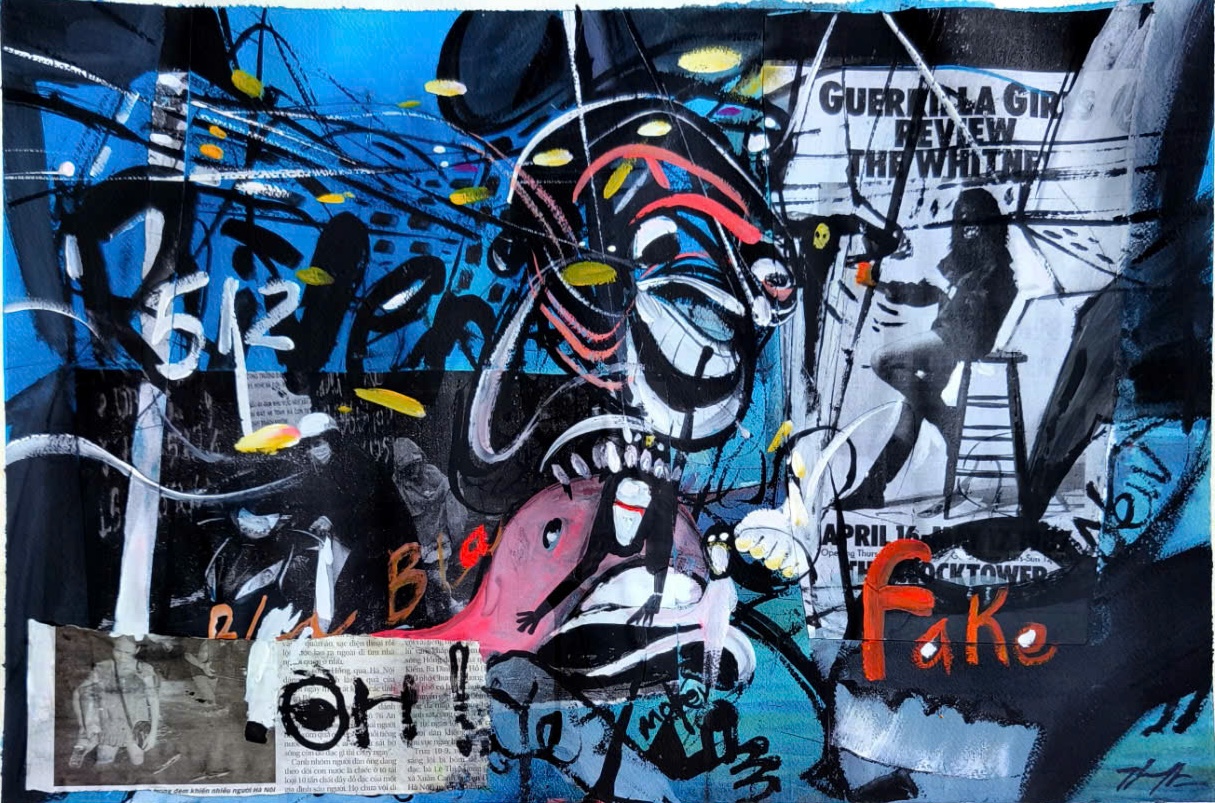

This collection is not conceived as a group of autonomous works, but as a continuous sequence of states. Painting here does not function as narrative, nor does it seek a fixed center of meaning. Each work operates instead as a point of visual compression, where images, signs, colors, and emotions overlap, collide, and remain suspended in an unsettled condition.
Working through a combination of collage and direct hand-drawn marks, Dương Thụy constructs pictorial surfaces that appear perpetually in the process of becoming. Fragments of urban life, mass media, social symbols, the human body, impulsive handwriting, and traces of violence emerge simultaneously, without linear order and without distinction between center and periphery. No single element dominates; each layer both asserts its presence and risks being obscured or erased.
Distorted faces, gaping mouths, recurring circular forms, and scattered textual fragments do not represent specific individuals or events. Rather, they function as indicators of a psychological and social condition stretched by contemporary rhythms—information overload, visual pressure, fragmented memory, and the persistent sense of intrusion. Within this context, painting no longer serves to explain the world, but to register the human reflex in response to it.

The rhythm of the collection oscillates between two poles: eruption and restraint. Some works are dense, aggressive, and nearly violent in their visual intensity; others recede into silence, leaving sparse and fragile spaces amid an unrelenting flow of imagery. This oscillation forms the internal structure of the collection—unstable in form, yet consistent in its articulation of lived experience.


This body of work does not ask to be understood. It opens a field of sensation, inviting viewers to remain, to confront, and to recognize their own points of friction within it. Painting here is no longer an image of the world, but a trace of what it means to live with the world in a state of uncertainty.