Bui Chat CollectionBay Tam Nam

Bay Tam Nam is an abstract painting series conceived under a deadline. Here, painting is not treated as an object meant to endure indefinitely, but as a living process—born, sustained, and then allowed to withdraw. Using a special solvent mixed into pigment, each work is “programmed” to fade over time; after seven to eight years, the surface returns to its original state: a white canvas. Time is no longer external to the artwork—it becomes the artwork’s internal structure.


If I could, I would attach a small label to each painting:
“Warning: This work will self-destruct within 7–8 years. No responsibility if you love it for too long.”
– Bui Chat


The title Bay Tam Nam also signals an attitude. It evokes the idea of having ngầu in a local card game—a condition that allows one to remain in the hand. Transposed into artistic practice, ngầu is not bravado or hierarchy; it is the nerve to wager: to make, to risk, to lose, and to accept disappearance as part of value. If beauty is preserved forever, it becomes a perfectly embalmed object; here, beauty is returned to a natural order—birth, death, forgetting.
Visually, the series functions like a diary without words. Layered pigment, sweeping gestures, stains, drips, and spills register the intensity of a moment—as if the painting has just happened. Yet every trace also carries the seed of dissolution: colour is present not only to be seen, but to slowly depart. Viewers therefore stand before two movements at once: the emergence of colour, and the promise of its absence.
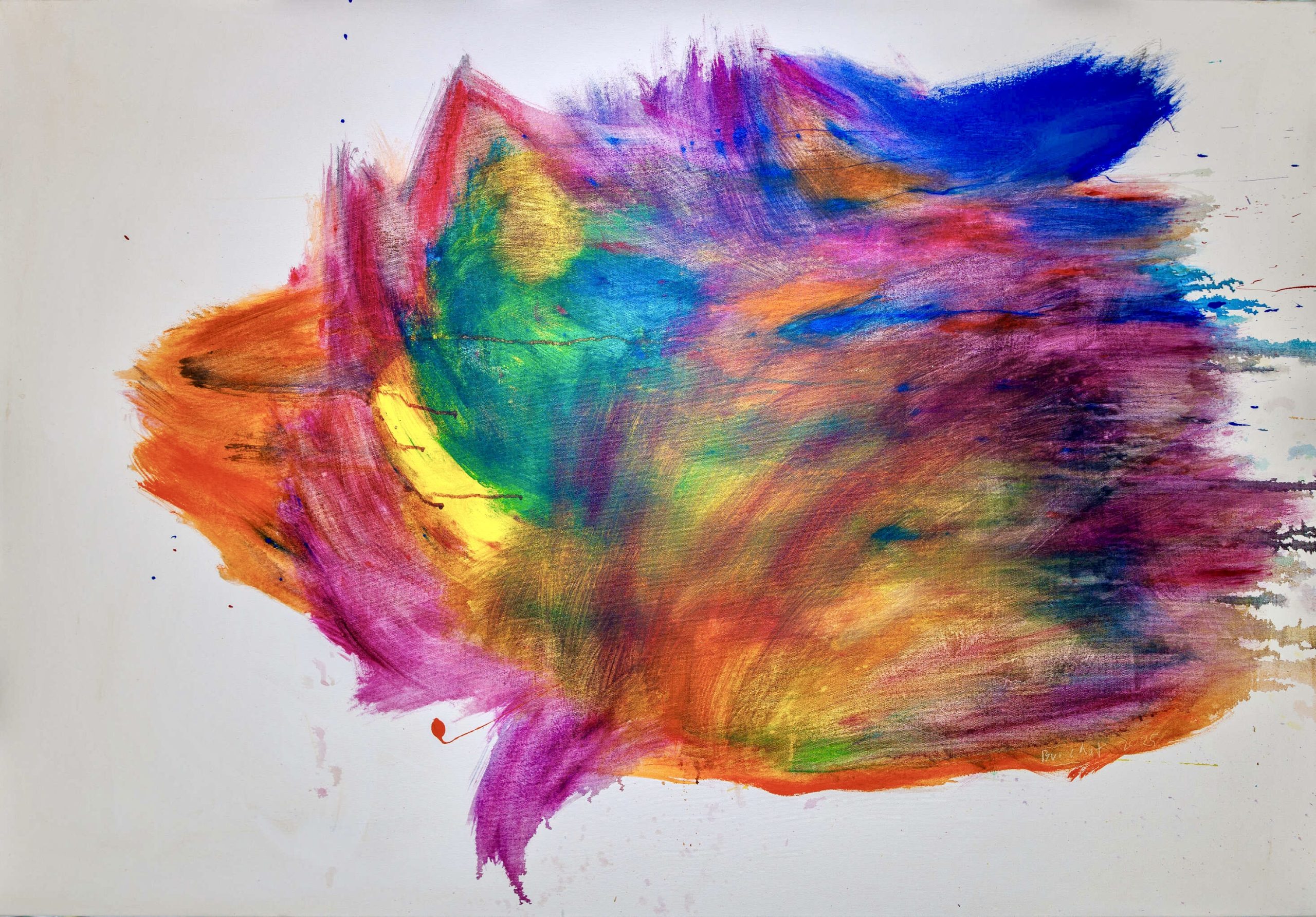
Within this paradox, Bay Tam Nam raises questions of memory and possession. When a painting fades, what remains—an object, or an encounter? Do viewers remember what they once saw, or does memory dissolve with colour? At its core, the series is not only about painting; it is about how we live with the limits of all things—bodies, feelings, what we love. Each work becomes a countdown clock, where every gaze is both a meeting and a step closer to the moment when there is nothing left to see.


By allowing the painting to die “on schedule,” Bùi Chát releases the work from the artist’s illusion of immortality—and releases the viewer from the need to keep. Value here does not lie in permanence, but in the intensity of the moment, in daring to be fully present before beauty as it disappears. Because, as in every hand of cards, perhaps only what is about to be lost truly exists.